SEO in 2026: What Still Works and What’s Dead
Is SEO dead? Someone declares it every year, and every year businesses that invest in search keep winning customers from it. But SEO in 2026 does not look like SEO in 2022. Google now answers many questions directly on the results page, AI assistants send visitors who have already done half their research, and Google’s spam systems are far less forgiving of shortcuts.
So the better question is not “is SEO dead?” It is “which parts of SEO still work, and which parts are wasting our time and budget?” This guide answers that in plain English and ends with a 90-day plan you can start this week.
Key takeaways
- SEO is not dead, but clicks are harder to earn. About 68% of US Google searches ended without a click in early 2026, according to SparkToro data.
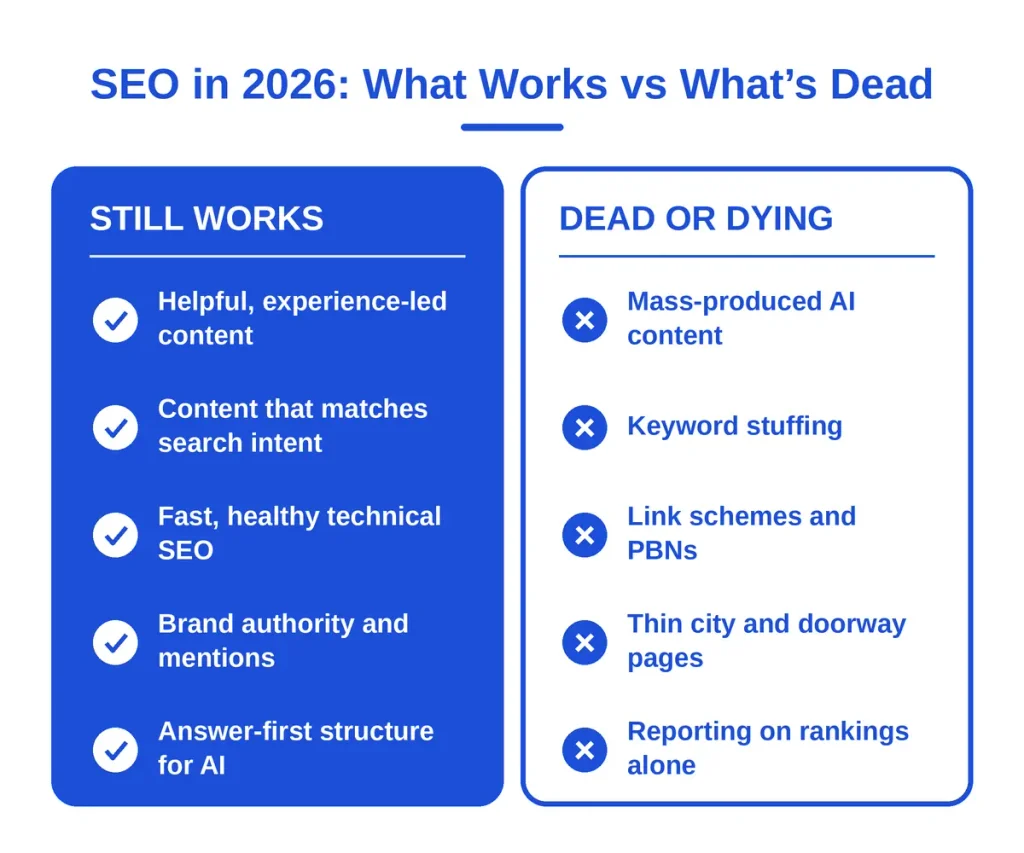
- What still works: helpful content built on real experience, matching search intent, solid technical health, strong brand authority, and answer-first formatting.
- What’s dead: mass-produced AI content, keyword stuffing, link schemes, thin location pages, and reporting on rankings alone.
- Being cited in AI answers is now part of visibility. Brands cited in AI Overviews earned more clicks than uncited rivals in one large 2026 study.
- GEO (generative engine optimization) does not replace SEO. It is good SEO plus clear structure and a strong brand presence.
How search changed in 2026
Before the playbook, you need the context. Three shifts explain most of what you are seeing in your analytics.
| Area | Old approach (2022) | What works in SEO in 2026 |
|---|---|---|
| Content | Long posts built around keywords | Answer-first, experience-led content with original insight |
| Keywords | Repeating exact phrases | Covering topics, search intent and natural language |
| Goal | Rank #1 on Google | Rank well and get cited in AI answers |
| Links | As many backlinks as possible | Quality links plus brand mentions across trusted sites |
| AI content | Publishing AI drafts at scale | AI-assisted drafts, reviewed and improved by experts |
| Technical SEO | Basic speed fixes | Core Web Vitals, structured data and clean crawling |
| Freshness | Publish and forget | Quarterly updates to your best pages |
| Reporting | Rankings and traffic | Leads, branded search and AI citations |
AI Overviews and AI Mode now sit on top of the results
Google’s AI Overviews summarise answers at the top of many results pages, and AI Mode lets people ask follow-up questions in a conversation instead of scanning a list of links. At its I/O event in May 2026, Google said AI Mode had passed one billion monthly users. For many searches, the first thing a person sees is no longer your page. It is an answer that may or may not mention you.
Zero-click searches are now the majority
SparkToro’s study found that roughly 68% of US Google searches ended without a click to another website in early 2026. A separate study published in April 2026 found that when an AI Overview appeared, outbound organic clicks fell by about 38% on those queries, and zero-click sessions rose from 54% to 72%.
The picture is not all bad. Seer Interactive’s 2026 research found that brands cited inside AI Overviews earned about 35% more organic clicks and 91% more paid clicks than uncited brands on the same results page. In other words, AI search filters out many low-value clicks and rewards the sources it trusts.
Google is enforcing its spam rules harder
Google ran two core updates in 2026 (late March to early April, and late May to early June) plus several spam updates, including a March update that finished faster than any spam update on record. The common target is “scaled content abuse”, which means publishing large volumes of low-value pages mainly to rank. Google also added back button hijacking to its spam policies in April and began enforcing it from June 15.
What still works in SEO in 2026
1. Helpful content built on real experience
Google keeps repeating the same message: write for people first. E-E-A-T (experience, expertise, authoritativeness and trustworthiness) is how that shows up in practice. Pages with first-hand experience, original examples, real data, named authors and clear sources are the ones both Google and AI tools can trust.
How to apply it:
- Add author names, short bios and credentials to articles.
- Include something only you can say: a client result, a screenshot, a test, or a lesson learned.
- Cite your sources and keep every claim accurate.
2. Search intent that matches the page
Ranking starts with giving people what they came for. Someone searching “best CRM for small teams” wants a comparison, not a definition. Before you write, search the keyword, look at what already ranks, and match the format: guide, list, comparison, product page or tool. Then go further than the current top results.
3. Technical SEO fundamentals
AI search has not made technical SEO optional. If your pages cannot be crawled, indexed and loaded quickly, nothing else matters. Make sure you have the basics covered:
- Clean crawling and indexing (sitemap, robots.txt, no accidental noindex tags)
- Fast, stable pages that pass Core Web Vitals, including loading speed and responsiveness (INP)
- Mobile-friendly design
- HTTPS and a clear site structure with strong internal links
- Structured data (schema) for articles, products, FAQs, local businesses and reviews
4. Brand authority and quality mentions
Authority still decides who wins competitive searches. Quality backlinks from relevant sites still matter, but so do mentions of your brand across trusted places: industry publications, review sites, podcasts, YouTube, Reddit, LinkedIn and community forums. Being talked about in many credible places also makes it more likely that AI tools name you in their answers.
5. Answer-first structure for AI citations
AI systems and Google’s featured snippets both favour content they can lift cleanly. Write so that each section answers a question quickly:
- Put the direct answer in the first one or two sentences under each heading.
- Use clear H2 and H3 headings, ideally phrased as questions people ask.
- Keep paragraphs short and add lists, tables, definitions and specific numbers.
- Include an FAQ section with schema markup.
6. Fresh, maintained content
Old pages decay. A quarterly review of your most valuable pages (updating stats, screenshots, links and examples) is one of the cheapest wins in SEO. Show a visible “last updated” date, and only change it when you have genuinely improved the page.
7. Local SEO and reviews
For local businesses, a complete Google Business Profile, consistent name, address and phone details across directories, and a steady flow of genuine reviews remain among the strongest signals for map and local results.
What’s dead (or dying) in SEO in 2026
Mass-produced AI content
Using AI is not the problem. Publishing hundreds of thin, similar pages with little human input is. Google’s scaled content abuse policy applies whatever tool produced the pages. If a page adds nothing a reader cannot already get elsewhere, expect it to lose ground in the next spam update.
What to do instead: use AI for research, outlines and first drafts, then add expert review, original insight and fact-checking before anything goes live.
Keyword stuffing and exact-match writing
Repeating a keyword unnaturally, or forcing exact phrases into every heading, hurts readability and breaks Google’s spam rules. Search engines understand topics and synonyms. Write naturally, use your focus keyword where it fits, and cover the topic in depth.
Link schemes, PBNs and expired-domain tricks
Buying links, building private blog networks, hosting third-party content on a strong domain just to borrow its authority (site reputation abuse), and repurposing old domains for unrelated content are all targeted by Google’s spam systems. The short-term gain is not worth the risk of losing your visibility.
Thin location and doorway pages
Creating a near-identical page for every city you serve, especially cities where you have no presence, is classic doorway abuse. Build genuinely useful location pages with local details, real projects, team members and reviews, or do not build them.
Generic “what is” blog posts
A 500-word definition of a common term is exactly what AI Overviews now answer on their own. Informational content still has a place, but it needs original data, expert opinion or a unique angle to earn the click.
Reporting on rankings and traffic alone
Rankings and sessions no longer tell the full story. Impressions can rise while clicks fall because an AI answer is absorbing the visit. Measure what matters instead: qualified leads, sales, brand searches and visibility in AI answers (more on that below).
What’s overhyped: llms.txt and GEO shortcuts
GEO, or generative engine optimization, is the practice of making your content easy for tools such as ChatGPT, Perplexity, Gemini and Google AI Mode to cite. AEO (answer engine optimization) is a close cousin. Both are real, but they rest on the same foundations as good SEO: clear structure, trustworthy information, consistent brand signals and mentions across the web.
You may see advice to publish an llms.txt file, which lists your key pages for AI systems. It is cheap to create and harmless, but as of mid-2026 no major AI engine had formally endorsed it, according to one industry review. Treat it as a small extra, not a ranking lever. Your time is better spent on three things:
- Decide deliberately which AI crawlers you allow in robots.txt (for example GPTBot, PerplexityBot and ClaudeBot), because blocking them can reduce your chances of being cited in those tools.
- Add original statistics, expert quotes and clear definitions to your content.
- Keep your brand name, descriptions and details consistent across your site, profiles and directories.
Your SEO in 2026 action plan
Days 1 to 30: audit and fix
- Review Google Search Console for pages where impressions are up and clicks are down.
- Fix technical issues: indexing errors, slow pages and broken links.
- Audit your content for thin, duplicate or outdated pages. Merge, update or redirect them.
- Pick 10 to 20 priority keywords tied to revenue, not just traffic.
Days 31 to 60: upgrade your best pages
- Rewrite your top pages with answer-first sections, author bios, original data and FAQs.
- Add structured data (schema) where it fits.
- Improve internal linking from your strongest pages to the pages that make you money.
- Update your Google Business Profile if you serve local customers.
Days 61 to 90: build authority and track AI visibility
- Publish one or two in-depth, original pieces (research, case studies, expert guides) rather than many thin posts.
- Earn mentions through guest posts, podcasts, digital PR, reviews and community answers.
- Test 20 buyer-style questions in ChatGPT, Gemini, Perplexity and Google AI Mode, and note whether your brand is mentioned. Repeat monthly.
- Review the results and double down on what moved leads, not just traffic.
How to measure SEO success in 2026
Track a mix of signals instead of rankings alone:
- Qualified leads and revenue from organic search (the metric that matters most)
- Impressions, clicks and click-through rate in Google Search Console
- Branded search volume, which shows growing awareness
- Rankings for priority keywords, as a supporting metric rather than the goal
- AI citations and mentions across ChatGPT, Gemini, Perplexity and AI Overviews
- Engagement and conversions, such as time on page, scroll depth and form fills
People who do click after reading an AI answer are often more qualified, so a smaller amount of traffic can still produce more leads.